Published by GeoPoliticsToday on November 22, 2023
By Louis Power
November 21, 2023
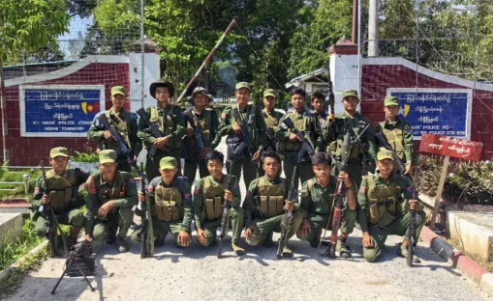
On October 27th, the Three Brotherhood Alliance targeted several military checkpoints and military junta bases in the North of the Shan State, capturing the key border town of Chinshwehaw and instigating attacks in several cities of the region, including Lashio, Hsenwei, and Kutkai. This assault, labeled Operation 1027 marks a significant development in the ongoing Myanmar civil war, demonstrating the renewed strength of united anti-junta forces as the war enters a new phase.
Myanmar is a nation located in Southeast Asia, it is geographically the largest in mainland Southeast Asia with a population of 55 million. Bordered by India and Bangladesh to the west, China to the north, Laos and Thailand to the east, and the Bay of Bengal to the south, Myanmar lies in a geo-strategic location in between the world’s two most populous countries. Myanmar’s modern history following independence from the British has been fraught with ethnic conflict and social unrest, and the nation has been ruled by a succession of authoritarian military juntas since the 1960s. Myanmar’s fate seemed to have changed following the 2010 elections, with the introduction of a democratic government under Aung San Suu Kyi which led to a period of economic growth and improved foreign relations with the outside world.
Since the outbreak of violence following the junta coup d’etat against the democratically elected National Unity Government, numerous armed ethnic insurgent groups have broken previous ceasefire agreements, attacking junta convoys and military bases, in turn renewing the state of internal conflict which has plagued the nation since 1948. Myanmar is a multi-ethnic state with a majority Bamar population, as such, discrimination and government crackdowns against independence movements are commonplace. This has created an environment in which armed ethnic organizations have become a mainstay of the political and security climate of Myanmar for decades. However, with the introduction of the PDF (an ethnically Bamar majority organization), Myanmar has witnessed an ethnically diverse opposition movement, containing the Bamar majority which is united in its opposition to the military junta.
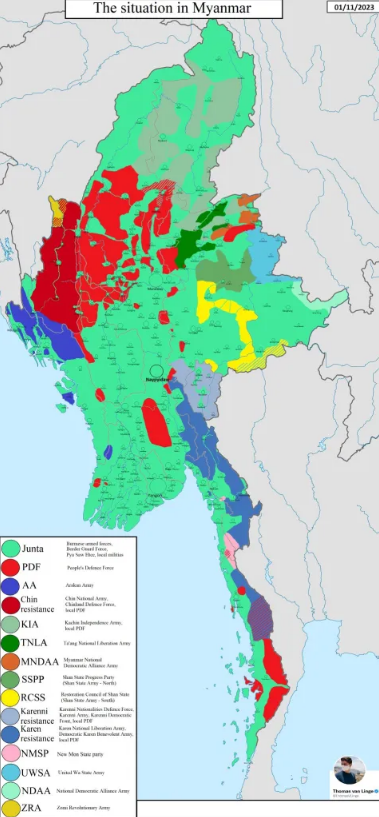
The Three Brotherhood Alliance (3BA) was founded in 2019 as an alliance between the Arakan Army (AA), Myanmar National Democratic Alliance Army (MNDAA), and the Ta’ang National Liberation Army (TNLA). All three members are ethnic armed organizations (EAO’s) and have been fighting the government for years within the Chin, Rakine, and Shan regions of Myanmar.
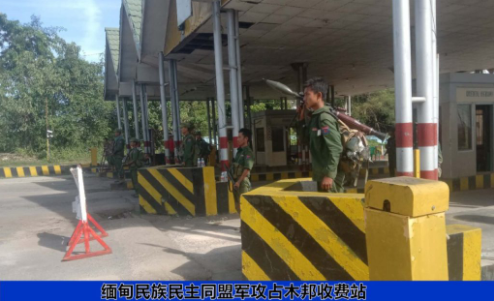
The first real concrete action 3BA has taken against the Tatmadaw was with Operation 1027. This offensive saw simultaneous attacks against junta forces in northern Shan State, capturing several military bases and most importantly, controlling the border with China. By establishing control over border crossings, EAO’s such the MNDAA and the TNLA are able to halt cross-border trade with China, costing the junta an estimated $423,000 each day in tax revenue to fund their military.
One of the objectives of this operation was to combat online gambling fraud, a major problem in Myanmar, especially along the border with China. Thousands of people are smuggled each year into countries in Southeast Asia and forced to work on behalf of the Chinese triads and other criminal elements, with an estimated 120,000 in Myanmar alone. These scam centers often house thousands of enslaved people who are forced to work in the multi billion dollar online gambling sector, or as scam callers in these centers. These criminal activities have caught the ire of the Chinese government as they are often run by members of the Chinese criminal underground.
Laukkai, the capital of the Kokang Self-Administered Zone, has been a particular focus of the 3BA offensive, as the MNDAA had previously administered the city and Laukkai is reported to be a regional hotspot for these reported scam centers. Many of the individuals in charge of these centers are ethnically Chinese, and the Chinese government has recently issued warrants for their arrest. Analysts have argued that this operation received the tacit approval of Beijing, as the MNDAA, which represents the Kokang Chinese, an ethnically Chinese Mandarin speaking group in the north of Shan state, is both culturally and politically aligned with China. As China exerts significant influence on this region of Myanmar, EAO’s in the region are vying for China’s favor, as evident by the hostile approach Beijing has taken towards the scam centers along its borders.
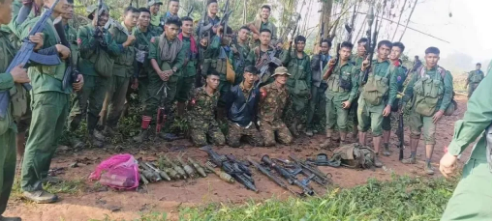
Operation 1027 also has a strong domestic impact in Myanmar as well. In the weeks since the success of the 3BA offensive in northern Shan State, two other operations have started in Kayah State, labeled Operation 1107 and Operation 1111. Orchestrated by Karenni EAO’s, the Karenni Army (KA) and the Karenni Nationalities Defense Force (KNDF), the overall aim of these operations is to capture Loikaw, the regional capital of the Kayah State. A successful capture of Loikaw, would further hinder the position of the Tatmadaw and increase morale amongst the anti-junta alliance. Elsewhere in Rakhine State, the AA has seized the initiative, breaking the previously established ceasefire and capturing several abandoned junta outposts near the regional capital of Sittwe.
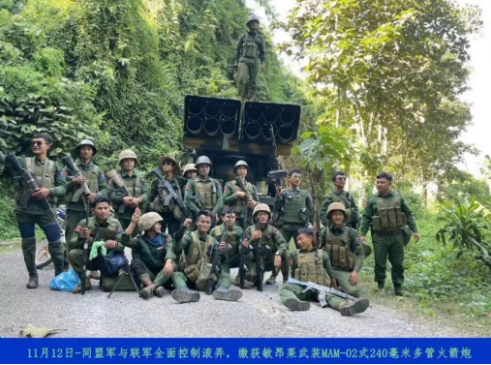
Operation 1027 has been a success for the 3BA, and the alliance has been able to put significant pressure on an already overwhelmed Tatmadaw. By controlling the border with China, the MNDAA and TNLA have caused significant economic difficulties for the junta and invited Chinese influence as they pursue their shared goal of cracking down on illegal online gambling and scam centers in northern Shan State. The success of Operation 1027 has provided inspiration to other non-state actors in the country to engage in their own operations in both Kayah State and Rakhine State, prompting the question of how effectively the Tatmadaw can handle multiple fronts at the same time, and if the actions of anti-junta forces can really topple the government in Naypyidaw.