Published by GeoPoliticsToday on March 24, 2025
By Louis Power
March 24th, 2025
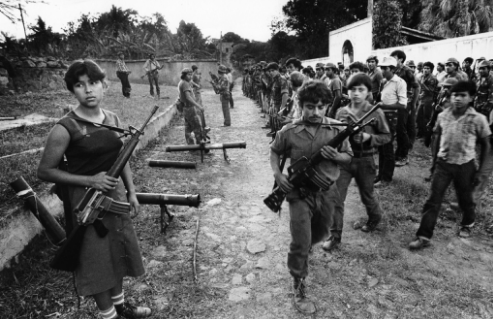
Once regarded as the most dangerous country in the Western Hemisphere, with a murder rate comparable to that of the active warzones of the Middle East, the small Central American nation of El Salvador recorded for the year of 2023 a homicide rate of 2.4 per 100,000, the lowest in the region. The country had a reputation of being plagued in violence, first, as the victim of a 12 year long brutal civil war that ended in 1992, costing an estimated 70,000 lives and leading to over a half a million international refugees, then as a center for criminal gang empires.
In El Salvador, two gangs were predominant, Barrio 18 and MS-13, however their origins begin in the United States. During the Salvadoran Civil War the destination for the majority of these refugees became the United States, specifically Los Angeles, leading to the formation of the infamous prison gangs, Barrio 18 and MS-13. These gangs became a scourge on the reputation of El Salvador, replacing the political violence of the civil war with gang warfare and are regarded as some of the most brutal criminal organizations in existence. With a widespread international influence and estimated membership of 100,000 between the two gangs, their violent behavior has given El Salvador a reputation for criminality and violence.
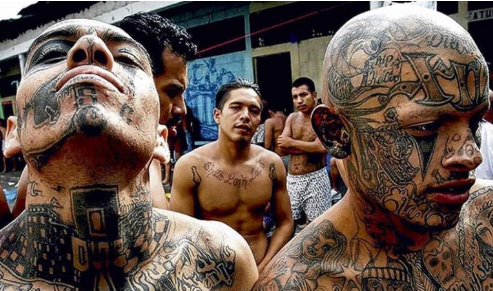
As mentioned previously, many Salvadoran refugees that became members of these gangs were deported from the US leading to an estimated 120,000 gang members out of a population of 6.6 million. With such a large proportion of the population associated with criminal elements, El Salvador experienced a surge in violence, peaking in 2015 with a murder rate of 103 persons per 100,000, for reference, the global average that year was 5.91 persons per 100,000.
For a nation held hostage by the influence of gangs, trapped in a cycle of despair and violence, only a radical figure could change the future of his nation, and in this case this was Nayib Bukele. Bukele got his start in politics in 2012 as mayor of Nuevo Cuscatlán as a young and relatively unknown local politician, but through his service to the community he represented his reputation increased within and he eventually became the mayor of San Salvador, the nation’s capital in 2015.
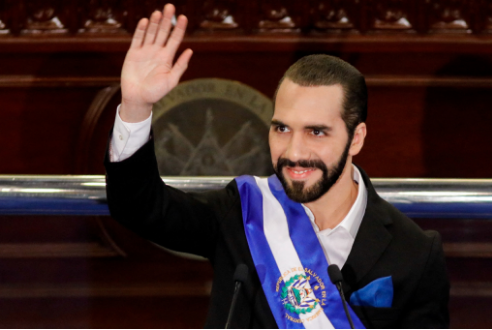
Bukele’s time in charge of San Salvador included revitalizing the city’s downtown district, combating crime through the installation of security cameras, and a scholarship program directed at the capital’s youth, turning them away from the corrupting influences of the gangs. While popular with the citizens, Bukele’s unorthodox method of politics led to public clashes with FMLN, the major party he represented while mayor of San Salvador, resulting in his expulsion from the party. Following this, Bukele established in 2017 his own party, Nuevas Ideas, ran for president in 2019 on a populist anti-corruption platform, winning and thereby becoming El Salvador’s youngest ever president.
Bukele ran under a platform of addressing the systemic gang violence that plagued El Salvador for the last two decades, a position that garnered widespread public support amongst Salvadoran voters. Bukele sought to crackdown on the gangs of El Salvador in a harsh manner as what had occurred under previous administration. Prior attempts to reduce gang violence had involved government truces as well as a policy known as La Mano Dura, The Iron Fist. Under this policy, police arrested suspected gang members based on appearance alone, leading to mass detentions and alleged human rights violations.
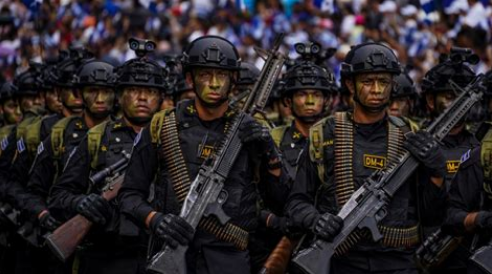
Under Bukele’s first administration, a similar policy to La Mano Dura was followed. An essential aspect of the government’s new approach was utilizing the military in its gang crackdown. The military were brought in to assist the national police force for operations targeting gang strongholds, these operations included raiding houses and creating checkpoints surrounding neighborhoods with known gang presences. Soldiers checked everyone for identification cards and proof of address, searched their vehicles and backpacks, and refused to let anyone enter or leave without what they considered a legitimate reason. Anyone considered suspicious was forced to strip so soldiers could check for gang-related tattoos.
Once arrested, suspected gang members would be sent to the newly built Terrorism Confinement Center. Regarded as the largest prison in Latin America, and one of the biggest in the world in terms of capacity, the Terrorism Confinement Center located in Tecoluca can house up to 40,000 prisoners and is the pinnacle of Bukele’s attempt at reigning in the Salvadoran criminal gangs. In order to keep prisoners under detention for longer periods of time new rules regarding prison sentences have been introduced. For gang leaders the prison sentence has jumped from six to nine years all the way to 40, members have also seen prison sentences increase to 20 to 30 years from a prior three to five year sentence. The large-scale arrests have led to El Salvador having a prison population of over 105,000 as of December 2023, leading to an estimated 1.7 percent of the population behind bars, the highest in the world.
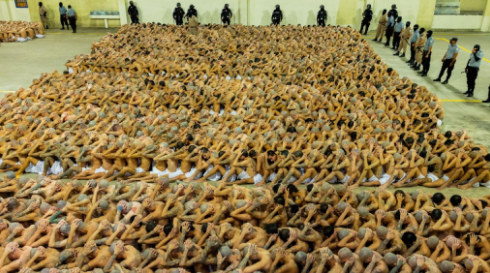
Bukele has been able to conduct the mass detention of suspected gang members through a “state of exception”, which allows for the suspension of rights of association and legal counsel, increased the amount of time an individual may be detained without being charged, as well as monitoring private communications without a warrant. This “state of exception” has been extended over 30 times, leading to accusations by opposition politicians and human rights activists that Bukele was using the gang crackdown as an excuse to overextend his influence and power over the country’s security apparatus. While concerns remain over Bukele’s heavy handed response to the gang conflict, his approval rating amongst El Salvador’s population is one of the highest in the world, standing at 85%. Furthermore, Bukele won 83% of the vote in his 2024 re-election campaign and 91% of Salvadorans supported the government’s implementation of the gang crackdown, demonstrating the trust the Salvadoran people have in Bukele to turn the fortune of their country around and end the continuous cycle of violence that has tormented their country.
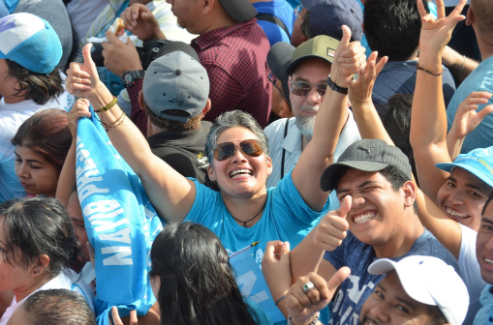
The impact Bukele had on El Salvador in the span of five short years is extraordinary, his heavy handed tactics have succeeded in not just curbing but significantly eliminating the gang presence in his country. The impact of his presidency extends beyond his national borders and in a region plagued by gang violence, to witness the textbook example of a state held hostage by gang influence turning into one of the safest nations is bound to turn heads and inspire other leaders in similar predicaments. Honduras, El Salvador’s neighbor, has enacted a similar version of the gang crackdown in December 2022, suspending parts of the constitution, strengthening police resources, building new prisons, and utilizing the military in anti-gang operations. However, the country which seems most keen to imitate Bukele and curb their problem with rampant gang violence and internal instability is Ecuador. Ecuador has witnessed a massive increase in violence, going from a murder rate of 5.7 per 100,000 in 2018 to 45.1 in 2023, making it statistically the most violent country in South America as well as hosting the city with the highest homicide rate, Durán, with 148 homicides per 100,000 residents.
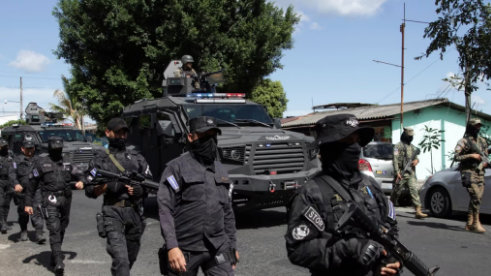
The impact of Buekele’s messaging seems effective especially in more impoverished nations within Latin America that have been victims of continuous cycles of violence and other nations may soon follow suit with increased heavy handed security measures to address organized crime.