Published by GeoPoliticsToday on December 24, 2023
By Louis Power
December 24, 2023
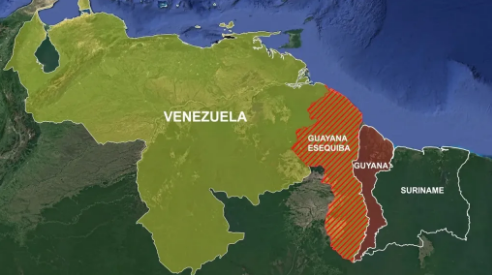
On December 3rd, 2023 the Venezuelan government held a referendum regarding the sovereign status of the mineral and energy rich Essequibo region of Guyana. The outcome of the referendum saw a resounding over 95% support, in turn giving the Maduro administration a mandate for unilateral annexation of the long time contested region. This has prompted Guyanese president Mohamed Irfaan Ali to issue a statement condemning the referendum, as Essequibo (also known as Esequiba) constitutes 70% of Guyana’s national territory. This political crisis has since witnessed a significant military buildup along the border which could easily lead to the outbreak of conflict. Additionally, this crisis in South America presents itself at a time when Nicolás Maduro faces a tough reelection campaign in January 2024, prompting several questions regarding the timing of the referendum and what the outcome of this crisis will consist of.
To get a better understanding of the dispute over Essequibo the historical context regarding the region must be examined. Essequibo had previously been a British colony dating back to the late 18th century, and in 1840 German-born explorer Robert Hermann Schomburgk was tasked with mapping British Guiana’s western boundary. The resulting proposed border was known as the Schomburgk Line along the Orinoco River, resulting in a dispute with the Venezuelan government in 1841. The dispute remained uncontested until the discovery of gold in the region in the late 19th century, prompting increased settler migration into the region and reigniting the issue which resulted in a diplomatic crisis between London and Caracas. What resulted was a US mediated Treaty of Arbitration in 1897, followed by a tribunal in 1899 that ruled in Britain’s favor regarding the status of the border and the matter was shelved, regardless of continued Venezuelan diplomatic protests.
In 1962, the dispute was reignited by the revelation of the Mallet-Prevost Memorandum that accused the British and Russian delegation in 1899 of collusion in favor of giving British Guiana a favorable portion of the disputed region. In 1966 following international mediation, the Geneva Agreement was signed by the governments of British Guiana (later as independent Guyana), The United Kingdom, and Venezuela. The Agreement was a temporary agreement to find a peaceful final solution via dialogue and diplomacy, which led to a freeze in negotiations through the rest of the 20th century.
The fate of Essequibo changed following the discovery of large oil deposits off its coastline in 2015. The discovery of an estimated 8 billion barrels of oil instantly propelled Guyana into the spotlight, with now one of the largest proven oil fields in the globe. This discovery reignited the issue of Essequibo, with the Venezuelan government lodging a complaint in the International Court of Justice requesting a final ruling regarding the sovereignty of the disputed territory, however a definitive ruling has yet to be issued.
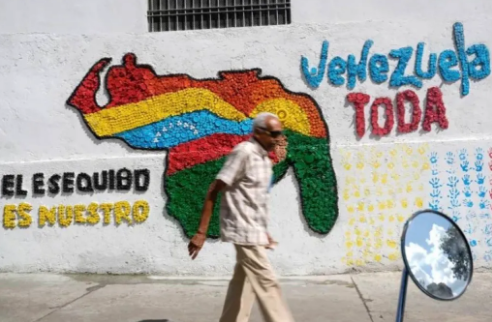
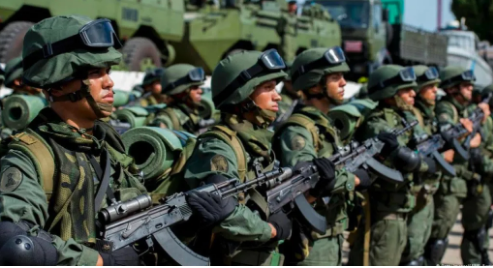
Tensions in the region erupted following the announcement on October 23rd, 2023 of a consultative referendum regarding the status of the Essequibo region. The outcome of the referendum, according to the Venezuelan government, was a 95% vote in favor of creating a new state titled Guyana Esequiba, and in turn incorporating the state into Venezuela at a future date. Following this referendum, numerous regional organizations such as the Caribbean Community, the Commonwealth of Nations, and the Organization of American States rejected the referendum, in addition to the United Nations. Furthermore, Maduro’s rhetoric towards the “reclamation” of Esequiba has sparked military mobilization along the Venezuelan-Guyana border. The increased militarization of the border provides a possibility of invasion of Essequibo by Maduro, further exacerbated by the fact that Venezuela’s military dwarfs Guyana’s in terms of manpower and equipment.
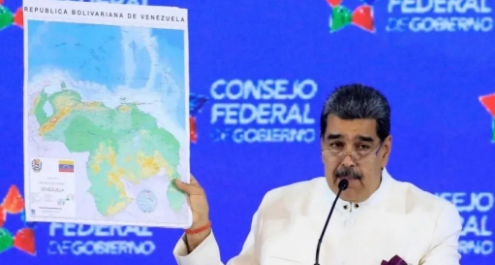
The timing of the referendum and the following political crisis between Guayana and Venezuela comes at a time of increased domestic internal crisis in Venezuela as well as a period of heightened global tensions. Political analysts believe Maduro may be attempting this aggressive stance in regards to Essequibo as a way of rallying nationalist elements in Venezuela around him as he attempts to win reelection ahead of the January 2024 elections. Others have noted a similarity between Maduro’s rhetoric and Putin’s prior to the invasion of Ukraine and the annexation of Ukraine’s disputed Eastern and Southern oblasts. Maduro may be attempting to establish an annex with other authoritarian leaders in Russia and China, to oppose US interests in the region, as if an invasion were to occur, it would likely spark US involvement to a similar degree as in Ukraine. Either way, the crisis in Essequibo benefits Russia as it would distract a war-weary America by opening another “front” while the war in Ukraine rages into its third year.
The situation on the ground is fluid and dynamic, since the December referendums and the military mobilization, little has changed in the recent weeks as Guyana prepares itself for what is to come next. The variable in this crisis is Maduro, will he win reelection in January? Will this in turn prompt him to continue down the path of outright annexation? The elections on January 10th will likely influence how the crisis pans out and put into question how willing Venezuelans are to wage a conventional war in the midst of economic hardships during a period of international sanctions. Finally, the United States is an important actor in the region, how the American military responds to such an action is a telling factor of how successful Venezuela’s land grab may be.
While the world is focused on the wars in Gaza and Ukraine, the brewing crisis in South America is one to certainly watch out for. This is as with Ukraine and Taiwan another example of smaller democracies bullied by their larger, and more powerful authoritarian neighbors, prompting real fears about the decay of the rules-based liberal order across the globe.